
Self-Belief: The Bedrock Beneath Confidence
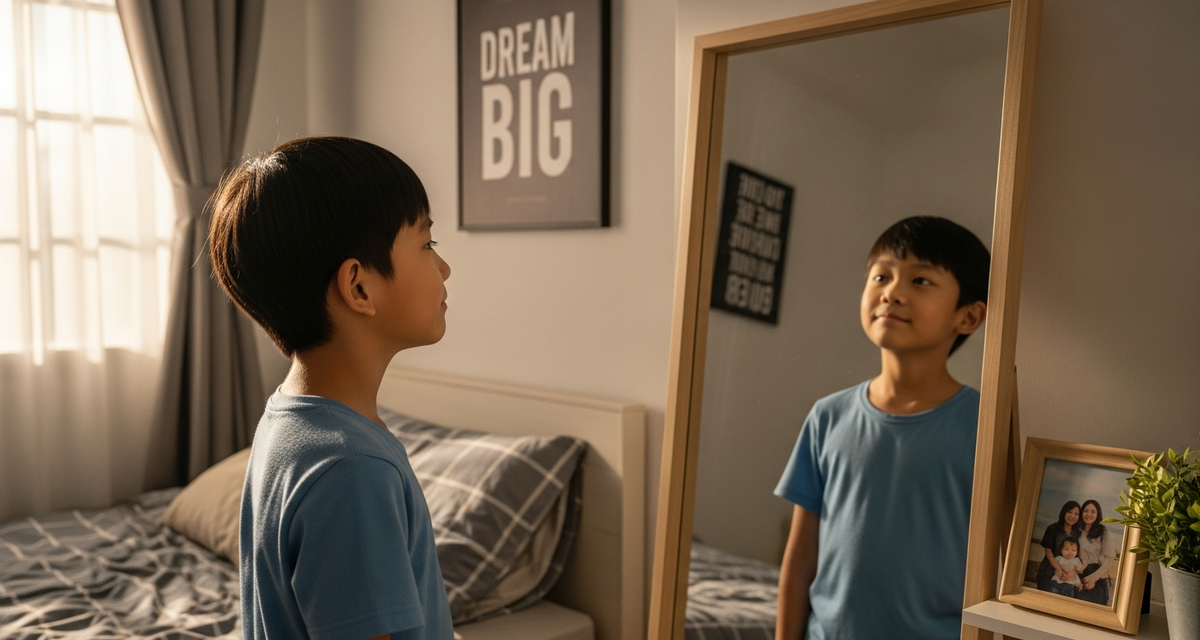
Confidence in a specific skill — public speaking, maths, sport — rests on a deeper foundation: the belief that one is capable of learning and improving. Psychologists call this self-belief, and it's distinct from both self-esteem (sense of worth as a person) and self-confidence (belief in specific task competence). A child with genuine self-belief doesn't need to already be good at something to attempt it — they trust that effort will lead somewhere.
This matters profoundly in practice. Children with high self-belief attempt challenges their equally capable but lower self-belief peers avoid. They recover from setbacks faster. They interpret criticism as information rather than condemnation. They are, in short, dramatically more learnable.
How Self-Belief Forms — and How It Erodes
Self-belief forms primarily through what psychologist Albert Bandura called "mastery experiences" — the accumulated record of attempts, efforts, and small successes that tell a child: "My efforts produce results." These experiences create a self-reinforcing cycle: belief → attempt → small success → stronger belief.
Self-belief erodes through two main pathways: persistent criticism that focuses on fixed attributes ("You're not smart enough for this") rather than modifiable effort, and a pattern of avoiding challenge that prevents mastery experiences from accumulating. The child who is repeatedly told they "can't" and rarely attempts things that feel difficult develops a belief system that frames difficulty as evidence of incapacity rather than evidence of stretch.
The Growth Mindset Connection
Carol Dweck's seminal research on growth mindset maps directly onto self-belief. Children with a growth mindset — who believe their abilities are developable through effort — show dramatically greater resilience, greater willingness to attempt challenging tasks, and greater academic outcomes over time compared to children with a fixed mindset.
The language we use with children either reinforces growth or fixed mindset framing. "You're so smart!" reinforces a fixed attribute. "You worked really hard on that and it shows!" reinforces the belief that effort produces results. Over thousands of interactions, this language profoundly shapes self-belief architecture.
Rebuilding Self-Belief After Criticism or Setbacks
Children who have experienced significant criticism — particularly around academic performance or social standing — often arrive with an eroded self-belief foundation that manifests as reluctance to attempt, resistance to feedback, and a protective avoidance of anything where failure is possible.
Rebuilding begins with guaranteed small wins: tasks calibrated just below the child's current anxiety threshold, designed to succeed. Each success deposits into the self-belief account. The art is calibrating the challenge — too easy and there's no genuine mastery; too hard and failure reinforces the existing belief. Our programme is carefully structured to provide this calibration for communication confidence specifically, with trainer-guided progression that ensures early wins even for the most avoidant children.
Daily Practices That Compound Self-Belief
The "I did" inventory: Each evening, ask your child to name three things they did today — not achieved, but did. Any action counts. This builds the habit of recognising their own agency and effort. Effort-based praise: Consistently praise the process — preparation, persistence, strategy — not the outcome. "You kept going even when it was hard" is more self-belief-building than "You're so clever." Mistake normalisation: Celebrate mistakes as evidence of attempted stretch. "You made that mistake because you were trying something hard — that's worth being proud of."
Communication as a Self-Belief Amplifier
Public speaking is a high-leverage domain for self-belief building because it's socially visible, emotionally loaded, and directly testable. A child who successfully speaks in front of an audience — however small — experiences a uniquely powerful mastery event. This is why structured public speaking coaching, done well, consistently produces self-belief transfers that extend far beyond speaking itself. Our progress tracker and workshop programmes provide structured environments where these mastery events happen reliably, frequently, and with expert support.
Self-Belief and Singapore's High-Achieving School Environment
Singapore's educational culture creates a particular challenge for self-belief development: it is performance-rich and mistake-visible. PSLE results are known to families. Class rankings are discussed. CCAs have competitive selection processes. In this environment, children with low self-belief face a compounding disadvantage — they avoid the challenges that would build mastery, falling further behind peers who attempt and fail and learn repeatedly.
The antidote is not to pretend the competitive environment doesn't exist, but to build a self-belief foundation strong enough to engage it from a place of curiosity rather than fear. Children who believe their efforts produce results — who have experienced this directly in a structured, supportive environment — approach competitive academic and co-curricular challenges with a fundamentally different orientation. Our programme is one of the most reliable contexts we know for building this foundation: it creates real mastery experiences, provides expert feedback that students trust, and produces visible, measurable growth that children can feel and parents can see.