

Beyond "Limit Screen Time" — What's Actually at Stake
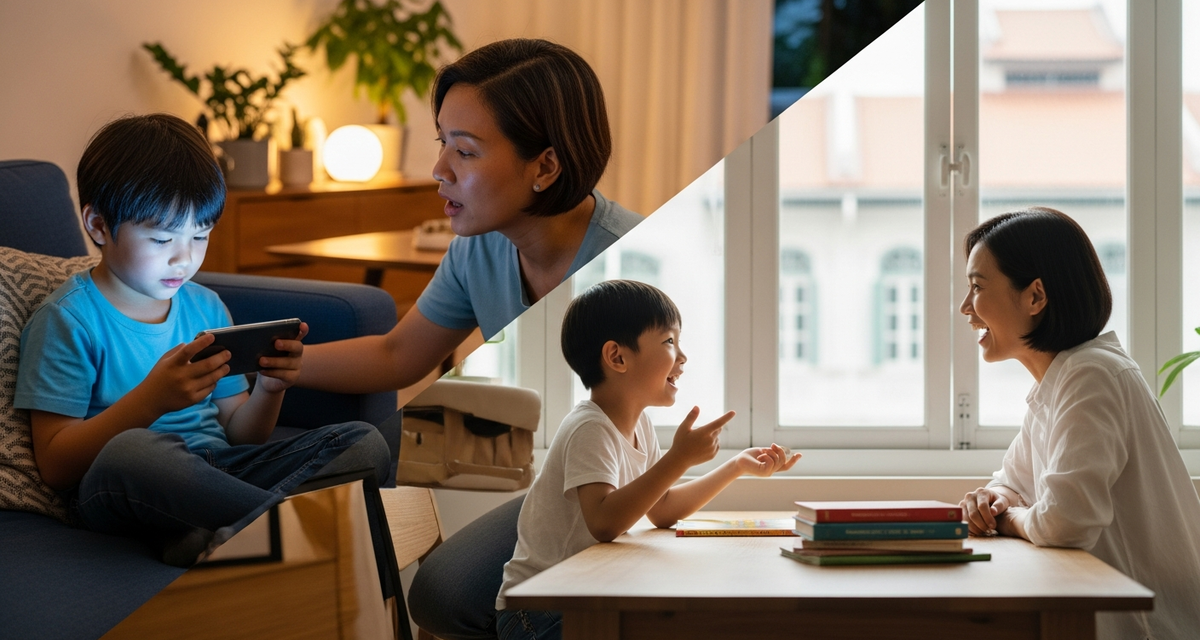
Most parents have received the general advice to limit children's screen time. This guide is different: it focuses specifically on four communication skills that are directly and measurably eroded by passive screen consumption, explains the mechanism behind each, and offers specific replacement practices.
The concern here is not screens in general — educational, interactive, and social uses of technology are genuinely valuable. The concern is passive, high-stimulation content consumption: videos that require nothing from the viewer except sustained attention, delivered in a format optimised for maximum watch time.
Communication Skill 1: Eye Contact
Sustained eye contact in conversation requires practice and comfort with another person's direct gaze. Children who spend significant time watching screens — where the content never looks back — are getting large volumes of visual experience without the reciprocal, socially contingent nature of real-world eye contact. Over time, the muscles of eye contact atrophy for want of use.
Replacement practice: during meals and conversations, practise active eye contact. Play the "3-second rule" game: hold eye contact with the speaker for 3 seconds before looking away. This sounds minor but is deeply impactful when practised consistently.
Communication Skill 2: Expressive Vocabulary
Children build vocabulary through two pathways: receptive exposure (hearing or reading words) and expressive use (using words to communicate). Screen consumption provides receptive exposure but almost no expressive use — the child receives language but produces none. Without the pressure of real communication to activate and consolidate vocabulary, words heard on screen don't transfer into spoken vocabulary.
Replacement practice: after any show or video, ask "What happened? Tell me in your own words." This simple demand activates expressive vocabulary and cements what was received passively.
Communication Skill 3: Turn-Taking in Conversation
Real conversation has a rhythm — one person speaks, the other listens, both track the exchange, and turns transfer through subtle cues (sentence completion, tone shifts, eye contact, body language). Screens provide zero practice in this reciprocal dance. Children who watch large volumes of content without equivalent real conversation time sometimes struggle with conversation pacing — they either dominate (because they're used to being the audience of a monologue) or struggle to contribute (because responding in real time feels effortful).
Replacement practice: structured dinner-table conversation with explicit turn-taking: everyone contributes, no one interrupts, and contributions must respond to what the previous speaker said (not introduce a new topic).
Communication Skill 4: Tolerance for Silence and Thinking Time
High-stimulation content creates an expectation of continuous input. Children who are used to content that never pauses develop reduced tolerance for the natural silences in conversation — pauses while someone thinks, transitional moments between topics, the normal rhythm of unhurried dialogue. This manifests as conversational rushing, verbal filling (um, like, basically), and discomfort with reflection questions.
Replacement practice: deliberately introduce thinking time in conversation. When you ask your child a question, wait — count to 7 silently before prompting again. This models that silence is productive and communication is not a race.
What to Replace Screen Time With
Face-to-face conversation and oral activities are direct alternatives to passive screen time when children need communication practice. Our free speaking tools and emotion recognition game provide interactive activities designed for children. Our public speaking programme and workshops add structured peer interaction and trainer feedback.
A Realistic Approach That Does Not Require Eliminating Screens
The goal is not to eliminate screens — that is neither realistic nor necessary. The goal is to ensure that the hours spent on screens are not the primary source of a child's daily communication experience. If your child speaks to other humans — at home, in school, in structured activities — for longer than they passively consume screen content each day, the communication risks are manageable. The problem arises when passive screen consumption is the dominant activity and face-to-face interaction becomes the exception.
A simple audit: count the hours of face-to-face conversation your child has on a typical weekday. If that number is lower than their screen time hours, begin by adding structured conversation time — not by removing screens. Add before you subtract. A dinner table conversation game, a 10-minute walk with genuine talking, or a shared book-reading session each add high-quality communication time without the resistance that comes from removing something your child enjoys. Once communication habits are established, the screen time question becomes less urgent because the skill development is already happening consistently.