
Confidence Is Not a Destination — It's a Developmental Arc
One of the most common misconceptions parents hold about public speaking confidence is that it's a binary state: your child either has it or doesn't. In practice, confidence develops through identifiable stages, and understanding which stage your child is in determines what kind of support is most helpful right now.
At School of Confidence, we work with children across the full spectrum — from those who have never willingly spoken in front of more than two people, to those preparing for national competition stages. The developmental arc looks different at each stage, but the progression is predictable and achievable.
Stage 1 — Awareness: Knowing Yourself as a Speaker
The first stage is self-awareness: understanding your own communication patterns, strengths, and anxiety triggers. Children at this stage need non-threatening opportunities to observe themselves — through video, through reflection exercises, through structured self-assessment. They begin to build a vocabulary for their experience: "I look down when I'm nervous," "I speak too fast when I'm excited."
Parent support at this stage: provide low-stakes speaking opportunities (family dinner sharing, telling a story to a grandparent) and ask reflective questions afterward. "What do you think went well?" builds the habit of self-observation without the pressure of external judgment.
Stage 2 — Exposure: Practising in Safe Spaces
Once children can observe and name their speaking habits, the development work begins: frequent practice in progressively expanding safe spaces. This means home first, then small trusted groups, then slightly larger groups. The key principle is that each new context should stretch — not overwhelm.
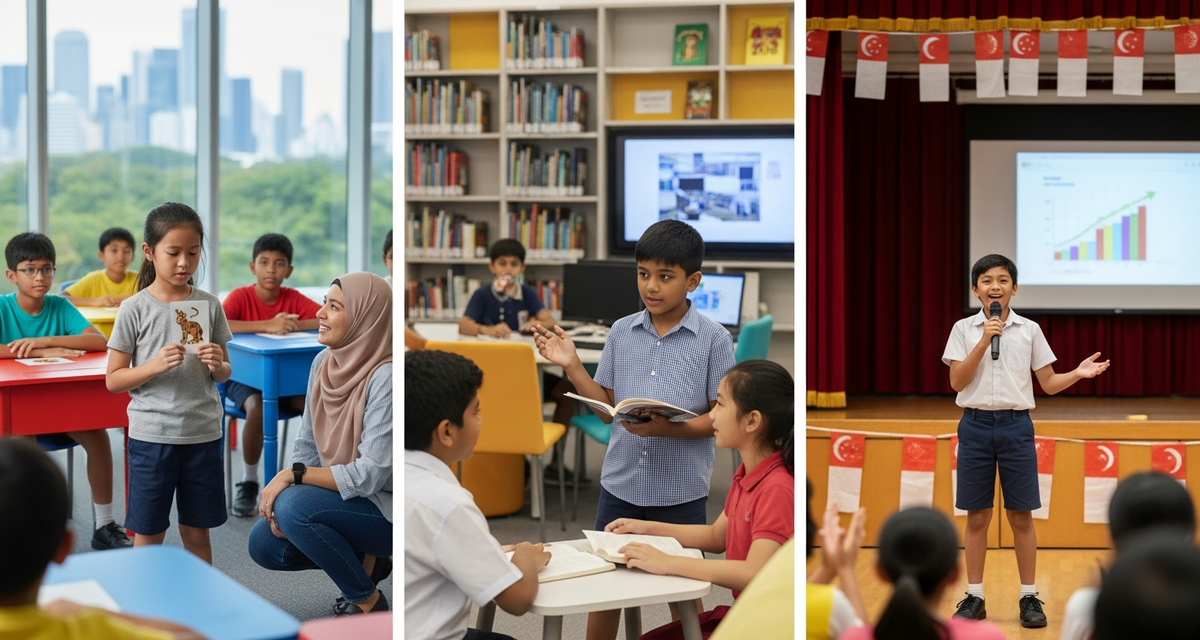
Our programme is designed specifically for Stage 2 children: small groups (maximum 6 in standard public speaking classes), structured formats that reduce uncertainty, and trainers who build psychological safety before introducing challenge.
Stage 3 — Feedback: Integrating Structured Coaching
Stage 3 is where skilled feedback becomes transformative. Children who have enough comfort to practise regularly can now receive specific, actionable guidance on their technique — eye contact, vocal variety, structural clarity, body language. Without this feedback, Stage 2 practice can plateau into comfortable mediocrity.
Good feedback at this stage is always specific, always actionable, and always balanced (strength + development). "Your opening was really engaging — the question you used pulled us in immediately. The next step is to slow down during your main points so we can absorb them" is effective. "Good job, but speak slower" is not.
Stage 4 — Application: Real-World Performance
Stage 4 children apply their skills in genuine, higher-stakes contexts: school presentations, oral assessments, competitions, interviews, CCAs. The goal here is not eliminating nerves — it's performing effectively despite them. Nerves become energy rather than interference.
Our workshops and holiday camps often serve as Stage 4 accelerators — providing a concentrated, expert-facilitated environment where children practise under simulated pressure and receive professional feedback on real-world performance.
How Long Does Each Stage Take?
Stage 1 typically requires 2–4 weeks of regular reflection. Stage 2, with consistent practice, takes 8–12 weeks. Stage 3 develops continuously over months to years — there's no ceiling on skill refinement. Stage 4 is an ongoing practice, not a destination.
Track your child's progress using our communication skills progress tracker, which provides structured observation frameworks for parents to monitor development across each dimension. Understanding which stage your child is in — and what's needed to move forward — is the most valuable thing a parent can know. If you're unsure, a trial class with us will give you a clear picture within one session.
Why Singapore Parents Should Think in Stages, Not Shortcuts
Singapore parents often ask for the fastest path to speaking confidence. The honest answer is that there is no shortcut through the four stages — but there is definitely a faster path through each one. Children who practise more frequently, receive expert feedback, and have supportive home environments move through each stage in months rather than years. The four-stage framework is not a limit; it is a map. And like any good map, it is most useful when you know exactly where you are on it.
School of Confidence's programme and workshops are designed to accelerate children through Stages 1 and 2 efficiently, provide the structured expert feedback that is essential to Stage 3, and create the real-world performance opportunities — presentations, interviews, competitions — that define Stage 4. Parents who understand this framework become meaningfully better coaches at home: reinforcing the right things at the right stage, rather than inadvertently rushing a child who needs more safety or holding back a child who is ready for greater challenge.