
The Unique Communication Challenge for Homeschooled Children
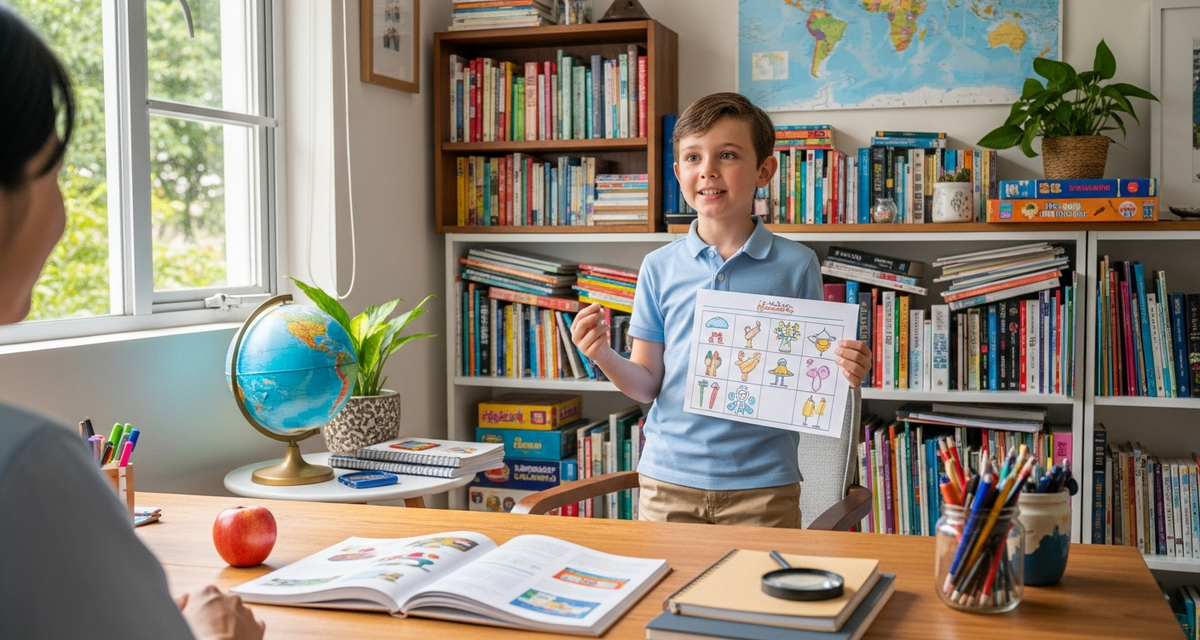
Homeschooled children in Singapore often receive excellent individualised academic instruction but have fewer organic opportunities for peer speaking practice than school-based children. Without classroom presentations, group discussions, school speeches, and the daily social negotiation of a school environment, homeschooled children can develop strong knowledge but limited practice with the specific challenges of speaking to audiences beyond their immediate family.
This is a solvable challenge. With intentional structure and periodic external input, homeschooled children can develop communication skills that match or exceed those of school-based peers. The key is building a systematic programme rather than leaving speaking practice to chance.
A Weekly Structure That Works
Build a consistent weekly speaking routine: Monday — select a topic (use our free topic generator for inspiration). Tuesday — draft and rehearse. Wednesday — deliver to the family for informal feedback. Thursday — refine and independent practice. Friday — full delivery with a slightly extended audience if possible (grandparents via video call, a family friend).
This structure ensures at least one full "speech cycle" per week without creating overwhelming preparation demands. Over a term, the progression in structure, confidence, and vocabulary is typically dramatic.
What a Homeschool Communication Curriculum Should Cover
A comprehensive homeschool public speaking curriculum for children should address five core domains: voice projection and clarity (can they be heard clearly across a room?), narrative structure (can they organise their ideas with a beginning, middle, and end?), persuasive reasoning (can they support a position with reasons and examples?), active listening (can they respond meaningfully to what others say?), and question handling (can they respond confidently to unexpected questions?).
For children preparing for PSLE, add a sixth domain: stimulus-based conversation skills — the ability to engage an adult examiner in extended, coherent dialogue from a visual prompt. Our free tools page provides resources for several of these domains.
Building Peer Speaking Experience
The most difficult aspect of homeschool communication development is replicating the peer audience experience. Family audiences are loving and non-threatening, which is excellent for building initial confidence but insufficient for developing the specific skill of speaking to peers with mixed motivations.
Solutions: create a local homeschool speaking group (3–5 children, weekly rotating topics), enrol in School of Confidence's group classes alongside school-based students, or use holiday camps where the peer mix is naturally diverse. Holiday camps are particularly popular with homeschooling families because they provide an intensive burst of peer interaction in a structured, safe environment.
How School of Confidence Supports Homeschooled Families
We work with a significant number of homeschooled children at School of Confidence. Our programme scheduling is flexible and can often be adapted to fit homeschool routines. Our holiday camps and weekend workshops are particularly compatible with homeschool schedules and provide exactly the peer interaction and expert coaching that home-based education can struggle to replicate.
For homeschooled children preparing for external examinations (including PSLE for those following MOE's home-based registration pathway), our A for Oral programme specifically addresses the oral examination components that are typically the most unfamiliar territory for home-educated students. Contact us to discuss flexible scheduling and programme options.
Tracking Progress Without School Benchmarks
One challenge homeschooling families face is the absence of the school-based comparison points that flag whether a child is on track. Without class presentations, teacher assessments, or peer observation, it can be unclear how a child's communication development compares to age expectations. Our recommendation: use video. A 90-second recording of your child explaining a topic made today, compared to an equivalent recording from three months ago, provides clear and motivating evidence of real development. Many parents find the comparison striking — children are often far more fluent, organised, and confident than they realise, precisely because development is gradual and invisible from day to day.
Supplement video review with periodic external benchmarking — either through group workshops where your child can be observed alongside peers, or through a single assessment session with a coach. Both provide objective data that home observation alone cannot supply, and both are available through our programmes. Knowing where a child actually stands removes the guesswork and allows home practice to be deliberately targeted rather than broadly attempted. Many homeschooling parents are pleasantly surprised to find their children performing at or above the level of school-based peers — confirmation that a well-structured home programme, consistently applied, is a fully capable substitute for classroom speaking practice.